
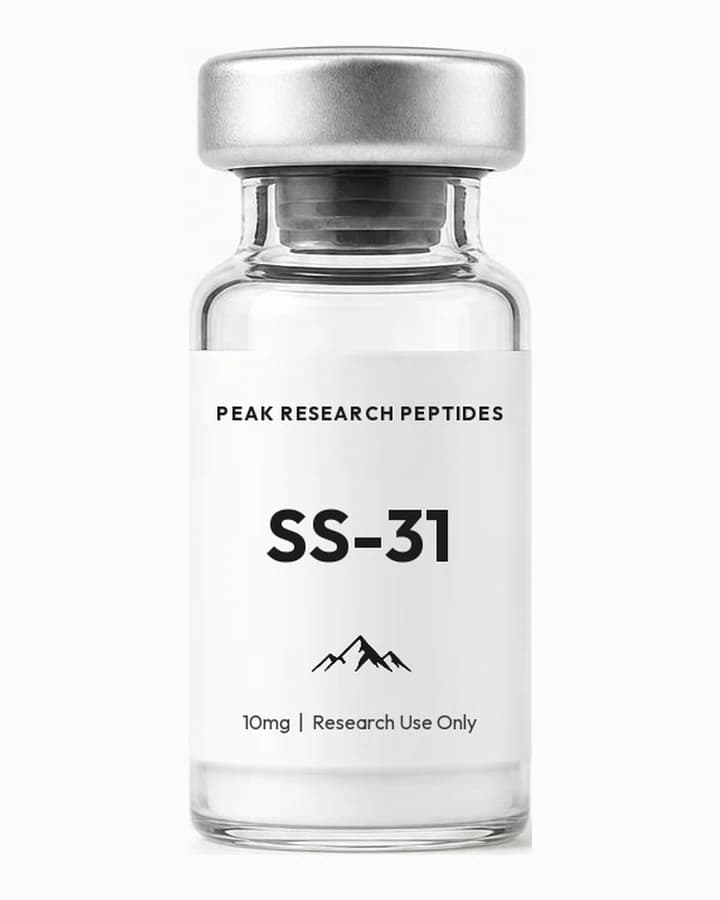
SS-31
Synthetic mitochondria-targeted tetrapeptide supplied for in-vitro research.
Every lot of SS-31 is analysed against the specification below before any vial is released.
| Parameter | Result | Method | |
|---|---|---|---|
| Appearance | White lyophilised powder | Visual | White lyophilised powder |
| Purity | ≥ 99.00% | HPLC | ≥ 95% |
| Identity | Confirmed | HPLC / MS | Meets specification |
| Heavy metals | Not detected | ICP-MS | Pass |
| Sterility | No growth | PCR | Pass |
| Endotoxin | Within limit | USP <85> | Report |
Analysis is carried out on every lot before release. If you are supplying material onward, run your own confirmatory testing on arrival — our work supports yours, it does not replace it.
- Presentation
- 10 mg / vial
- Molecular formula
- C32H49N9O5
- Molecular weight
- 639.8 g/mol
- CAS
- 736992-21-5
- Grade
- Research use only (RUO)
For laboratory and research purposes only. Not for human or animal consumption.
Peer-reviewed research on SS-31, indexed in PubMed. Listed so you can read the primary sources directly.
- Circ Heart FailTargeting Mitochondrial Dysfunction With Elamipretide (SS-31) Improves Skeletal Muscle Performance in a HFpEF Rat Model
Vahle B, Weidner S, Tomalka A et al.
- Biomed PharmacotherSS-31@Fer-1 Alleviates ferroptosis in hypoxia/reoxygenation cardiomyocytes via mitochondrial targeting
Zheng H, Ou J, Han H et al.
- Int J Mol SciElamipretide: A Review of Its Structure, Mechanism of Action, and Therapeutic Potential
Tung C, Varzideh F, Farroni E et al.
- GeroscienceAging, mitochondrial dysfunction, and cerebral microhemorrhages: a preclinical evaluation of SS-31 (elamipretide) and development of a high-throughput machine learning-driven imaging pipeline for cerebromicrovascular protection therapeutic screening
Patai R, Patel K, Csik B et al.
- MitochondrionApplication research of novel peptide mitochondrial-targeted antioxidant SS-31 in mitigating mitochondrial dysfunction
Du X, Zeng Q, Luo Y et al.
- Antioxidants (Basel)Elamipretide(SS-31) Attenuates Idiopathic Pulmonary Fibrosis by Inhibiting the Nrf2-Dependent NLRP3 Inflammasome in Macrophages
Nie Y, Li J, Zhai X et al.
These papers are the published research on this molecule. They are not a claim about this product, and nothing here describes an intended use. All material is supplied for laboratory research only.